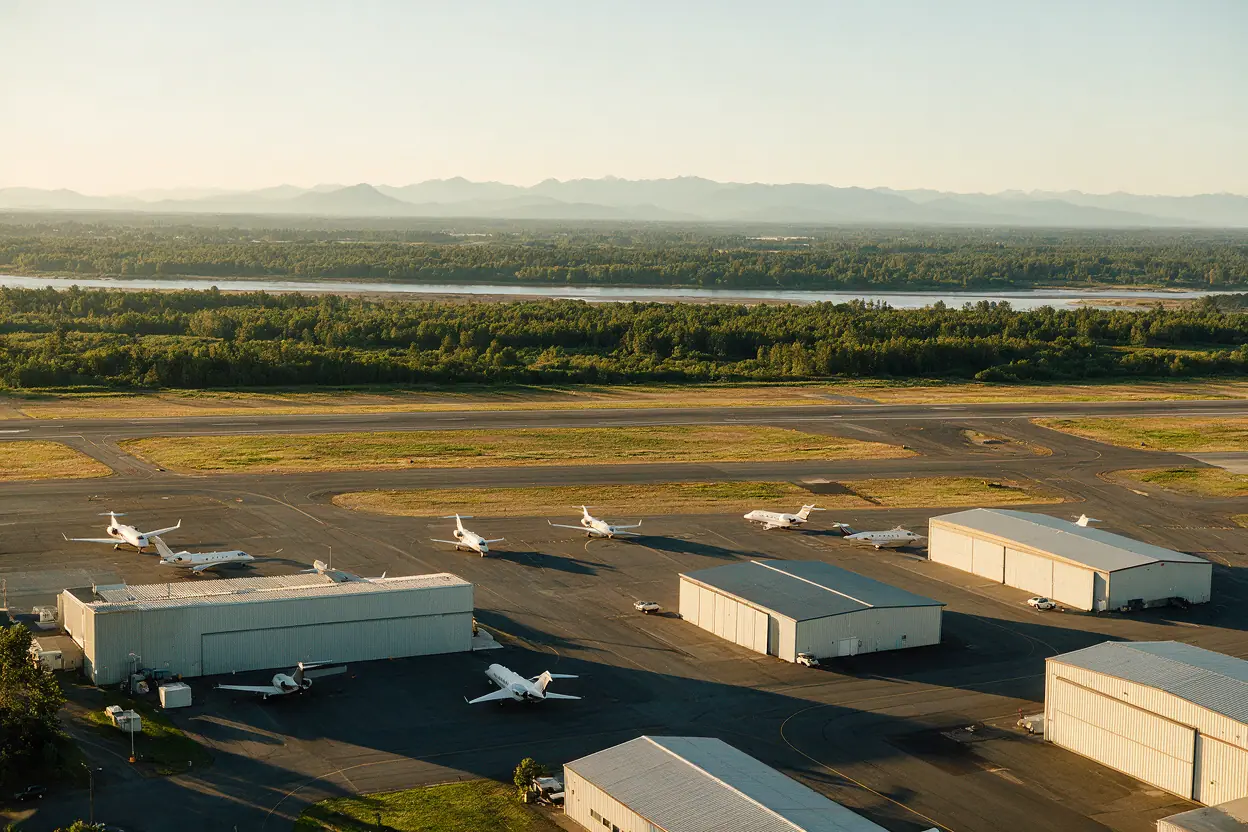
Private jet Washington Dulles
Washington Dulles handles private charters alongside its airline traffic. Its main runway runs 11,500 feet, which gives charter jets plenty of margin. This guide covers runways, FBOs, summer heat and planning.
- KIAD · IADfield codes
- 312 ftfield height
- 11,500 ftlongest runway
- 0 mito New York
Washington Dulles International (IAD) sits in the Virginia suburbs west of the District, and it functions as one of the region's main gateways for private charter flights. The field elevation is a modest 312 feet, so arrivals and departures rarely stress aircraft performance the way mountain airports do. A private jet Washington Dulles charter can use a runway that runs 11,500 feet, long enough for large-cabin jets headed to the West Coast or overseas.
For anyone comparing quotes, the practical point is that Dulles is a big, capable airport with real infrastructure, not a small reliever field. That means more aircraft types can serve it and scheduling is generally less constrained by runway limits. Charter flights from Washington Dulles benefit from 11,500 feet of runway and three on-field or nearby FBO options.
Because Dulles is a commercial hub, private travelers should expect to share airspace and ground movement with airline traffic. That does not usually cause problems, but it shapes how you plan. Slot times, taxi routing and FBO choice all matter more at a hub than at a quiet county field. Private jets at Dulles share the field with airlines, so ground planning deserves a little attention.
FBOs serving private flights
Dulles has two on-field FBOs, Atlantic Aviation and Signature Aviation, with APP Jet Center at Manassas as a nearby alternative. Atlantic Aviation and Signature Aviation both handle private charter flights at Washington Dulles. Which one your flight uses depends on the operator and the hangar or ramp space available on your date. Ask which FBO is assigned when your quote is confirmed, because it affects where you park and how long the drive is to the terminal. Manassas is a separate airport to the west, useful if your destination or pickup is on that side of the region. If you are meeting a car service, then give the driver the FBO name rather than the airport code alone.
Trips that suit this airport
- Transcontinental departures where the long runway and hub infrastructure support large-cabin jets.
- Government and business travel into the District, where Dulles is a familiar arrival point.
- International legs, which clear customs on arrival at a port of entry such as Dulles.
- Groups needing two on-field FBO options and flexible ground handling.
| Class | Runway needed | Local |
|---|---|---|
| Turboprop | 3,300 ft+ | Within limits |
| Light jet | 4,000 ft+ | Within limits |
| Midsize jet | 5,000 ft+ | Within limits |
| Super-midsize jet | 5,200 ft+ | Within limits |
| Heavy jet | 5,600 ft+ | Within limits |
Getting to and from the field
Dulles sits about 26 miles west of downtown Washington, reached by the Dulles Toll Road and the Dulles Access Road, with the Silver Line Metro linking the airport to the city. Private jet Washington Dulles passengers usually arrive by car or Metro and transfer to their assigned FBO. Allow extra time in weekday rush hour, when the access road and the Toll Road both slow down. If your flight leaves early, then an overnight near the airport beats a pre-dawn drive from the District.
Routes passing Washington Dulles
These 6 private jet routes cover 199 to 2,129 nautical miles, with one-way light jet estimates running $4,000 to $36,000.
Weather and density altitude by season
Summer heat is the main performance factor at Dulles, with July highs averaging 89 degrees and density altitude near 2,400 feet. July afternoons push density altitude to about 2,400 feet at Dulles, which affects light jets most. The peak figure of roughly 2,900 feet is based on the hottest month's average high plus 8 F. Winter runs the other way. January highs average 43 degrees and density altitude drops well below sea level, which is good for performance but brings its own planning needs. Wet days cluster across the year, with 13 in May and 13 in July among the higher months. If you are flying in convective season, then build some slack into your departure window.
| Time of year | Mean max | Days of rain | Density alt |
|---|---|---|---|
| Jan | 43°F | 9 | -700 ft |
| Feb | 48°F | 11 | -300 ft |
| Mar | 56°F | 10 | 200 ft |
| Apr | 66°F | 12 | 900 ft |
| May | 75°F | 13 | 1,500 ft |
| Jun | 84°F | 12 | 2,100 ft |
| Jul | 89°F | 13 | 2,400 ft |
| Aug | 86°F | 13 | 2,200 ft |
| Sep | 80°F | 11 | 1,800 ft |
| Oct | 69°F | 8 | 1,100 ft |
| Nov | 56°F | 8 | 200 ft |
| Dec | 48°F | 9 | -300 ft |
Runways and field performance
Dulles has a long primary runway at 11,500 feet, and the field elevation of 312 feet keeps density altitude low across most of the year. The longest runway at Dulles stretches 11,500 feet, giving private jets generous takeoff margin. Summer is the main exception. On a hot July day the density altitude reaches about 2,400 feet. The peak of roughly 2,900 feet is based on the hottest month's average high plus 8 F. That is still manageable for most jets, but it is worth raising with an operator if you are flying a lighter aircraft on a long leg with a full cabin. Turboprops and light jets see the biggest effect. When you request quotes for a summer departure, tell the broker your passenger count and baggage load so performance is checked properly rather than assumed. If a hot-weather departure is tight, then a different aircraft or an earlier morning slot often solves it.
| Rwy | Length | Width | Surface |
|---|---|---|---|
| 01C/19C | 11,500 ft | 150 ft | CONC-G |
| 01R/19L | 11,500 ft | 150 ft | Concrete |
| 12/30 | 10,501 ft | 150 ft | Concrete |
| 01L/19R | 9,400 ft | 150 ft | Concrete |
Q&A for this airport
What runway does a private jet Washington Dulles flight use?
The primary runway runs 11,500 feet, though the specific runway depends on wind and traffic on your day. Field elevation is 312 feet, so performance is rarely a constraint outside summer heat. In July the density altitude sits near 2,400 feet, and the peak of about 2,900 feet is based on the hottest month's average high plus 8 F. That still works for most jets, but light aircraft on long legs should be checked carefully.
Which FBOs handle charter flights at Dulles?
Atlantic Aviation and Signature Aviation both operate on the field. APP Jet Center at Manassas is a nearby alternative if your plans point west of the District. The FBO assigned to your flight depends on the operator and availability on your date. Ask for the FBO name when your quote is confirmed so your ground transfer and driver go to the right building rather than a main terminal curb.
How long is the flight from Dulles to the West Coast?
Most midsize and large-cabin jets handle the run nonstop, while smaller aircraft may need a fuel stop. Exact block time depends on aircraft type, winds and routing, and your quote should state it for the specific jet proposed. If you are comparing options, then ask each quote to show aircraft type, range and whether a stop is included.
Does summer heat affect departures from Dulles?
Yes, modestly. July highs average 89 degrees and density altitude reaches about 2,400 feet, with a peak near 2,900 feet based on the hottest month's average high plus 8 F. That reduces performance for light jets and turboprops more than for large cabins. If you are flying a lighter aircraft with a full load on a hot afternoon, then a morning departure or a different aircraft type is usually the simplest fix.
Can I fly internationally from Dulles on a charter?
Dulles is a port of entry, so international arrivals clear customs there. For outbound international legs, paperwork and passenger manifest details need to be settled before departure. Confirm passport and visa requirements for your destination with the operator early. If your trip crosses a border, then expect CBP processing on the return and allow time in your schedule for it.
How do I compare charter quotes for a Dulles trip?
Ask each quote to list the aircraft type, year, passenger and baggage capacity, the FBO, and what the price covers, including crew, fuel and landing fees. Prices are estimates until the operator confirms availability. When comparing brokers, check whether they disclose their role under DOT Part 295. If one quote is far below the others, then ask what is excluded before you treat it as the best option.