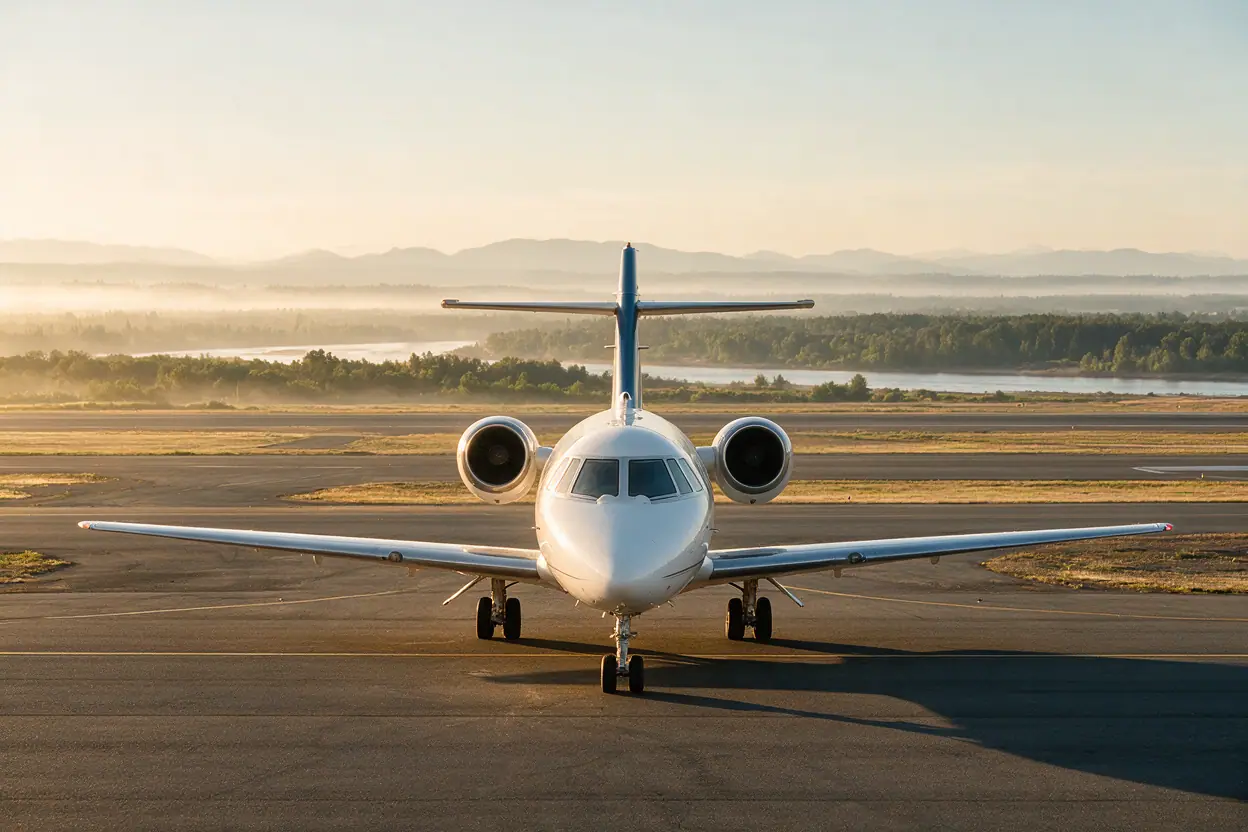
Midsize jet for charter in the US
A midsize jet for charter carries seven to nine passengers at about 440 knots. Expect quotes from $5,200 to $7,800 per hour for most US trips. This guide covers cabin sizes, routes, and how to compare estimates.
- $5,200–$7,800by the flight hour
- 7-9seats filled
- 2,100 nmnormal range
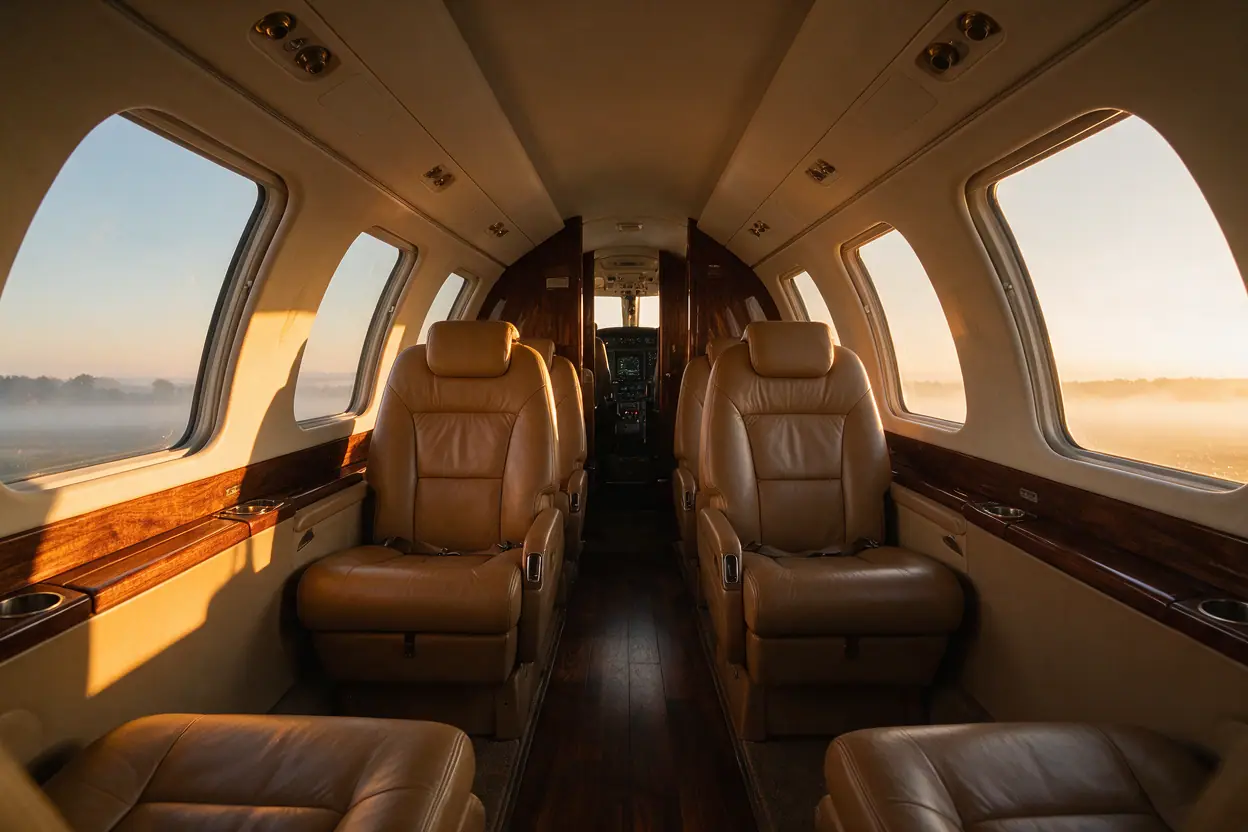
A midsize jet for charter sits between light jets and super-midsize models in both cabin size and operating cost. The cabin is typically about 5 feet 8 inches to 5 feet 9 inches tall and 18 to 21 feet long, enough for eight passengers to stand, move, and use a proper lavatory. A midsize jet for charter typically cruises at 440 knots with a range near 2,100 nautical miles, so it handles transcontinental US routes with one stop when needed. Two common types are the Hawker 800XP and the Cessna Citation XLS+, each with eight seats and similar speed but different baggage space. Charter quotes for a midsize jet usually fall between $5,200 and $7,800 per hour, depending on aircraft age, positioning, and season. For a short hop like Los Angeles to Las Vegas, 199 nm, expect a quote around $5,200 to $8,000. For New York to Miami, 949 nm, plan on $13,500 to $20,000. A midsize jet for charter is a practical choice for eight passengers on a 2,100 nm trip, balancing comfort and cost better than a light jet on longer legs.
Hawker 800XP
- 8 pax
- 447 kt cruise
- 2,540 nm legs
- 50 cu ft luggage
- 353 US registration
The Hawker 800XP carries eight passengers at 447 knots with a range of 2,540 nautical miles, giving it extra reach for coast-to-coast trips with a stop. The cabin measures 5 feet 9 inches tall and 21 feet 4 inches long, with 50 cubic feet of baggage space. Its runway performance suits airports like Aspen, though winter density altitude can limit fuel. Expect quotes in the upper half of the midsize range for this model.
Cessna Citation XLS+
- 8 pax
- 441 kt cruise
- 2,100 nm legs
- 90 cu ft luggage
- 733 US registration
The Cessna Citation XLS+ seats eight at 441 knots with a 2,100 nautical mile range. The cabin is 5 feet 8 inches tall and 18 feet 6 inches long, and baggage capacity is 90 cubic feet, generous for skis or golf clubs. It handles short runways well, making it a common choice for Los Angeles to Aspen at 634 nm. Quotes typically fall in the middle of the midsize band.
When a midsize jet makes sense
- When your group is seven to nine people with standard luggage, then a midsize jet for charter usually fits without weight restrictions. The cabin holds eight comfortably, and baggage bays range from 50 to 90 cubic feet depending on the model.
- If your route is between 900 and 2,100 nautical miles, then a midsize jet can often fly it nonstop. New York to Miami at 949 nm is a nonstop trip of about 2 hours 34 minutes in a midsize.
- When you need to reach a mountain airport like Aspen in winter, then check the aircraft's runway and climb performance. A midsize jet can use the 8,006-foot runway at Aspen, but density altitude on warm days affects takeoff weight and fuel stops.
- If you are comparing quotes for a transcontinental trip, then a midsize jet may require a fuel stop on routes like New York to Los Angeles at 2,129 nm. That stop adds time, so compare the total trip time and fees, not just the hourly rate.
What a midsize jet charter cannot do
A midsize jet cannot match the cabin or range of a super-midsize or heavy jet. If your group exceeds nine passengers or your route is over 2,540 nm nonstop, you will need a larger aircraft. A midsize jet for charter has a typical range of 2,100 nm, so transcontinental trips usually require a fuel stop. For international legs, customs and border clearance at your arrival airport adds time and must be arranged in advance. If your departure airport has a runway shorter than 4,000 feet, then confirm performance with the operator before booking a midsize jet. Mountain airports in winter may impose weight limits that reduce fuel or passenger load, so plan for a possible stop. When comparing quotes, ask whether the price includes landing fees, crew overnight, and fuel surcharges, since those can change the total significantly.
Popular routes and Midsize jet prices
Midsize jets handle many US routes nonstop, from short hops like Los Angeles to Las Vegas at 199 nm to longer legs like New York to Miami at 949 nm. For transcontinental trips such as New York to Los Angeles at 2,129 nm, a fuel stop is often needed. The estimates below show typical time and price ranges.

Midsize jet trip times and pricing by route
A midsize jet covers these 26 routes in 0h 30m to 6h 20m, with one-way estimates running $5,200 to $49,500.
| Trip | Duration | One-way est. |
|---|---|---|
| New York → Miami | 2h 34m | $13,500–$20,000 |
| New York → Los Angeles | 6h 08m + stop | $32,000–$48,000 |
| Los Angeles → Las Vegas | 0h 46m | $5,200–$8,000 |
| New York → Palm Beach | 2h 27m | $13,000–$19,000 |
| Los Angeles → San Francisco | 0h 58m | $5,200–$8,000 |
| New York → Aspen | 3h 53m | $20,000–$30,500 |
| Los Angeles → Aspen | 1h 49m | $9,500–$14,000 |
| New York → The Hamptons | 0h 30m | $5,200–$8,000 |
| Chicago → New York | 1h 47m | $9,000–$14,000 |
| Dallas → Houston | 0h 48m | $5,200–$8,000 |
| Miami → Nassau | 0h 41m | $5,200–$8,000 |
| New York → Boston | 0h 41m | $5,200–$8,000 |
| Washington, DC → New York | 0h 46m | $5,200–$8,000 |
| Los Angeles → Cabo San Lucas | 2h 14m | $11,500–$17,500 |
| Dallas → Las Vegas | 2h 30m | $13,000–$19,500 |
| Chicago → Miami | 2h 44m | $14,500–$21,500 |
| Atlanta → New York | 1h 50m | $9,500–$14,500 |
| New York → Las Vegas | 5h 40m + stop | $29,500–$44,000 |
| San Francisco → Las Vegas | 1h 09m | $6,000–$9,000 |
| Denver → Aspen | 0h 32m | $5,200–$8,000 |
| Houston → New York | 3h 15m | $17,000–$25,500 |
| Dallas → New York | 3h 09m | $16,500–$24,500 |
| Los Angeles → Honolulu | 6h 20m + stop | $33,000–$49,500 |
| Seattle → Los Angeles | 2h 15m | $11,500–$17,500 |
| Phoenix → Los Angeles | 1h 04m | $5,500–$8,500 |
| Boston → Palm Beach | 2h 47m | $14,500–$21,500 |
Good to know
How many passengers can a midsize jet for charter carry?
A midsize jet typically seats seven to nine passengers, with eight being the most common configuration. The Hawker 800XP and Cessna Citation XLS+ both carry eight. Baggage space varies from 50 to 90 cubic feet, so check with the operator if you have large items like skis or golf bags. For groups of nine, confirm the specific aircraft's seating before booking.
What does a midsize jet for charter cost per hour?
Hourly rates for a midsize jet range from $5,200 to $7,800, depending on the model, age, and positioning. A short trip like Los Angeles to Las Vegas at 199 nm often quotes $5,200 to $8,000 total. Longer legs like New York to Miami at 949 nm run $13,500 to $20,000. These are estimates; final quotes include taxes and fees.
Can a midsize jet fly nonstop from New York to Los Angeles?
Not usually. The route is 2,129 nm, which exceeds the typical 2,100 nm range of a midsize jet. A fuel stop is often required, adding time to the 6 hour 8 minute flight. Some models like the Hawker 800XP have a 2,540 nm range and may fly nonstop with favorable winds, but payload and weather affect that. Ask the operator for a specific trip plan.
How fast does a midsize jet for charter cruise?
Cruise speed is about 440 knots, or roughly 505 mph. The Hawker 800XP cruises at 447 knots and the Citation XLS+ at 441 knots. That speed puts Los Angeles to San Francisco at 279 nm in about 58 minutes and New York to Miami at 949 nm in about 2 hours 34 minutes. Actual time depends on winds and routing.
What is the range of a midsize jet for charter?
Typical range is 2,100 nautical miles, with some models reaching 2,540 nm. That covers routes like New York to Aspen at 1,503 nm nonstop, but not New York to Los Angeles at 2,129 nm without a stop. Range figures assume standard conditions; hot days, high airports, and headwinds reduce it. Always confirm with the operator for your specific route.
Which airports can a midsize jet for charter use?
Midsize jets can use most US airports with runways of 4,000 feet or more, including Aspen's 8,006-foot runway. They are common at both major commercial airports and smaller general aviation fields. If your destination has a shorter runway or high elevation, performance limits may apply. Provide the operator with your intended airports so they can confirm suitability.